
My first real camera bag was a Domke. As an aspiring photojournalist in college, it was the bag to have. The canvas bag didn't have all the padding of its competitors. This was the bag for the "working photographers" who saw their cameras as tools and not fashion accessories. Almost 30 years later that bag though faded and worn, is still a part of my inventory.
Domke has updated their classic F-2 canvas bags in a variety of additions including the one that I had the opportunity to review, The Chronicle, a member of Domke's Journalist Series. It has the familiar form and styling of the classic bag, but with some nice modern flourishes.
Design
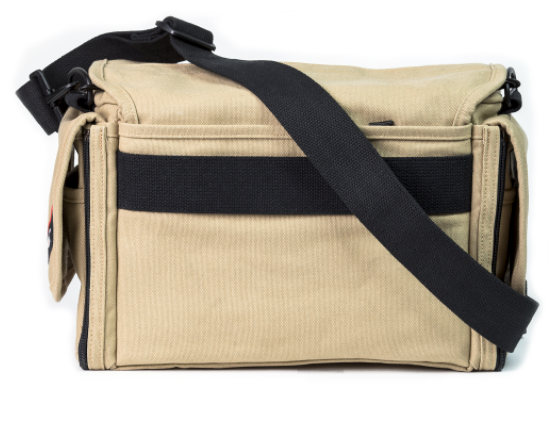
The Khaki color canvas with black webbing style that is classic Domke. The material provides ample protection for the bag's contents while providing a nice feel to the hands. The lack of padding allows the bag to weigh in at less than 4.5 pounds.
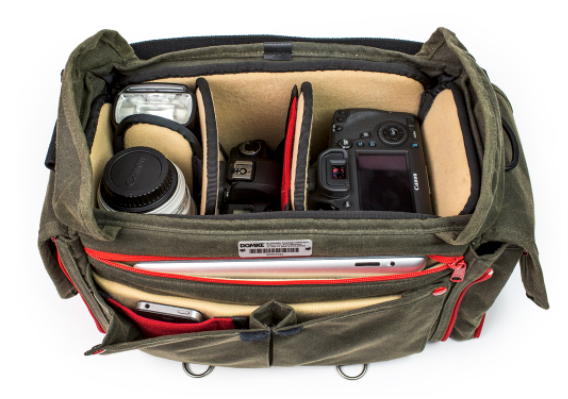
The interior provides ample space for DSLR or mirrorless cameras and multiple lenses, flash and other accessories, separated customizable partitions. The inserts are bendable and can be shaped to accommodate equipment to find your specific needs.
Besides the main compartment, the bag includes a pocket for a tablet up to 11-inches long as well as zippered side-pockets, which are ideal for storing a digital recorder or flash. It also features expandable front pockets.
Functionality
As a street shooter, I'm looking for a bag that allows quick and easy access to the limited amount of gear that I carry. That's particularly important when using a shoulder bag. The wide shoulder strap was wide and comfortable, whether it hung off my shoulder across my chest and shoulder. The large flaps allowed me to quickly access any area of the bag with the challenge of negotiating a zipper at an awkward angle. The flap that closes on the main compartment includes metal clasps for security, but also provides the option of Quick System Hook and Looper Silencer, which provides the option of open the bag with our without that familiar Velcro sound.
Strengths
The simplicity of the bag is its big strength. I'm not trying to carry everything and the kitchen sink with my anymore. I'm working relatively simply nowadays and just need enough space to carry my camera, a couple of lenses, a tablet, memory cards and some cables. I want protections, but don't want the design to prevent me from quickly being able to access the equipment that I need in a pinch. The Domke provides that.
Weaknesses
Because the bag is designed primarily for photojournalist, there is no convenient way of toting a tripod. For me, that's no big loss ad I rarely use a tripod.
Conclusions
It's been a while since I have used a "new" Dome, but I quickly found myself enjoying the familiarity of the bag, while appreciating some of the nice additions that I made to its design. The kept what where the obvious strengths of its original design, but included some nice additions such as the pocket for the tablet, to make it more ideal for the modern photographer.
I have purchased many bags in the past, most of which fallen into disuse after a time, but I think that the Chronicle will likely enjoy a long-life in my working life.